Media trader: the job marketing school never teaches you
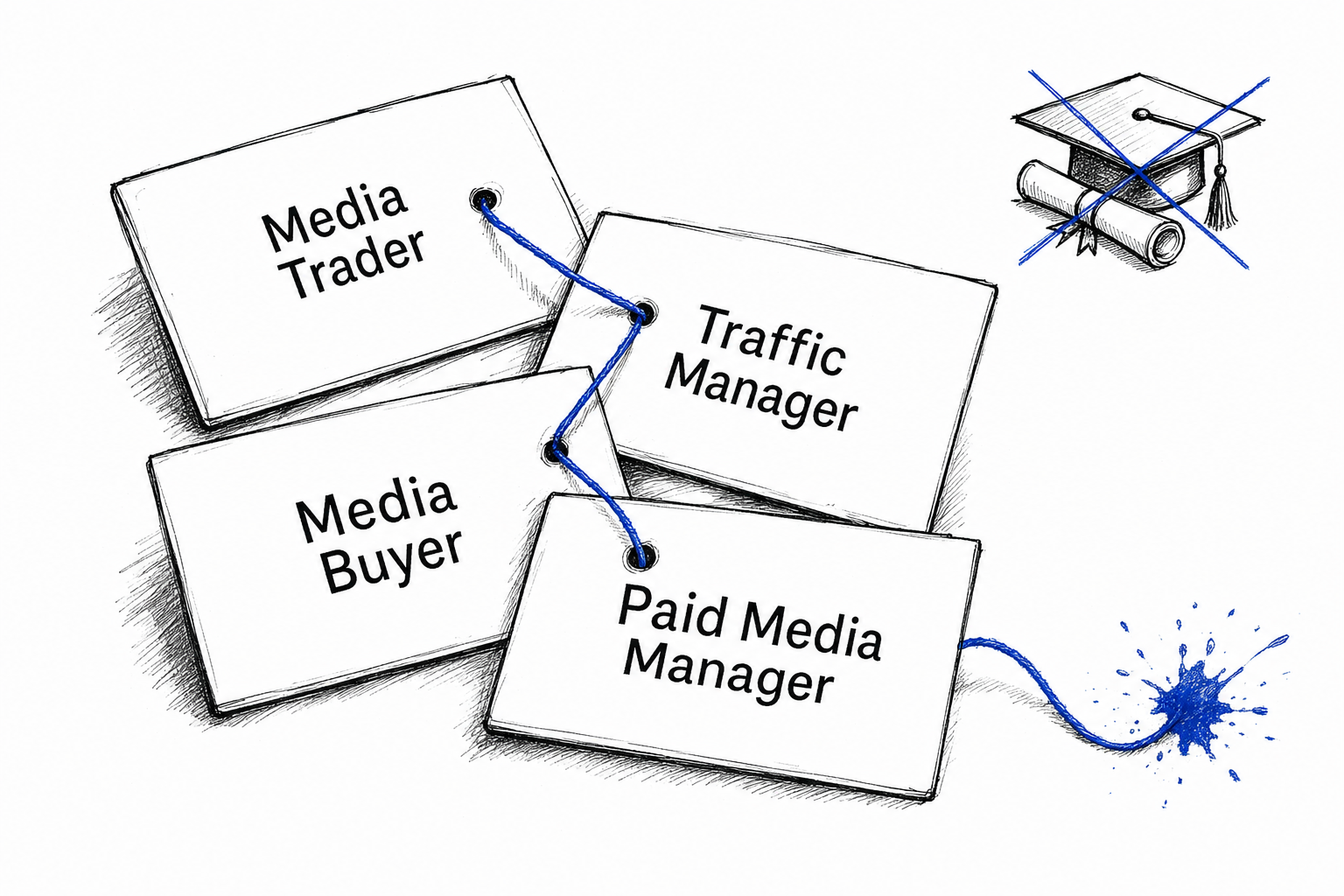
In marketing school, I got a class on brand content, one on storytelling, one on positioning strategy. Not one hour on media trading. Yet it’s one of the fastest-growing jobs in digital, and it’s the one that ended up paying my rent. I learned it on the job, same as half the market, and nobody ever agreed on what to call it.
People ask me what I do for a living. I say “media trader.” Polite silence. I try again: “I manage ad budgets on Google and Meta.” That usually clicks: “oh, like a community manager?” No. But I get the confusion: this job has at least six different names depending on the company, the decade, and whoever wrote the job posting.
One job, ten business cards
Media trader comes from finance, the idea that you “trade” budget across real-time auctions like a trading floor. Traffic manager is the older SEA-side title, from when the job meant almost nothing but Google Ads. Media buyer is the term you see more in agencies, or in companies that also buy offline media (TV, out-of-home). Paid media manager or paid media specialist took over once TikTok and Meta made the job bigger than just Google. Performance marketing manager stretches the scope further, often folding in CRO or email. Programmatic trader or DSP trader is the narrower version, focused on automated auctions and marketplaces like DV360 or The Trade Desk.
In practice, someone running three ad platforms with a 40,000€ monthly budget on the brand side gets called “media trader.” The same person, billed by an agency at a flat rate, gets called “traffic manager.” The actual work barely changes. The label just depends on who wrote the job description.
What you learn on the job, not in class
No syllabus prepares you for this: checking which budgets overspent or underspent overnight, nudging a couple of bids, refreshing a creative that’s fatiguing, replying to the account rep pushing a “preview” AI feature nobody asked for, and rebuilding an attribution number by hand because three platforms count it three different ways. The rest is reporting, client or internal check-ins, and constant watching, because the interfaces change faster than the official docs do. You learn it by clicking, by breaking a campaign, by fixing it.
Salaries, no taboo
In France, in 2026, gross annual ranges land roughly here, across all these job titles:
| Level | Gross annual salary |
|---|---|
| Intern / apprentice | €800 to €1,200/month |
| Junior (0-2 years) | €28,000 to €35,000 |
| Mid-level (2-5 years) | €35,000 to €48,000 |
| Senior / Lead (5-8 years) | €48,000 to €65,000 |
| Head of Acquisition (8+ years) | €65,000 to €90,000+ |
Two things matter more than the job title: Paris pushes salary bands up 15 to 20% compared to the rest of France, and agencies typically pay less than brands at the same level, but promote faster because you touch more accounts.
There’s a third thing, and it’s rare in marketing: here, performance often beats seniority. I’ve seen a one-year junior run an account better than an eight-year senior. Not about pay, about skill: platforms change every week, and a junior who keeps testing, breaking, and rebuilding ends up ahead of a senior who stopped keeping up. In this job, a ROAS number going up outweighs an “8 years of experience” line on a resume.
So if you see a “growth marketer” posting at €32,000 listing the same missions as a “senior media trader” at €45,000, that’s not a typo. In this job, the title on the business card usually says less than the actual job description. And no marketing school will ever put that in a course.